Why Is Tasks.Bot the Best for Voice-to-Task?
You dictated a task on the move, then it never made it to your team's list. Voice notes get lost in WhatsApp chats, and typing out every assignment costs field teams too much time.
By the end of this article, you'll know exactly how Tasks.Bot turns spoken instructions into assigned, tracked tasks. You'll see how its natural language AI handles voice notes, what the approval and reporting features cover, and whether the beta free trial fits your team's workflow.
What Is Tasks.Bot and Who Is It For?
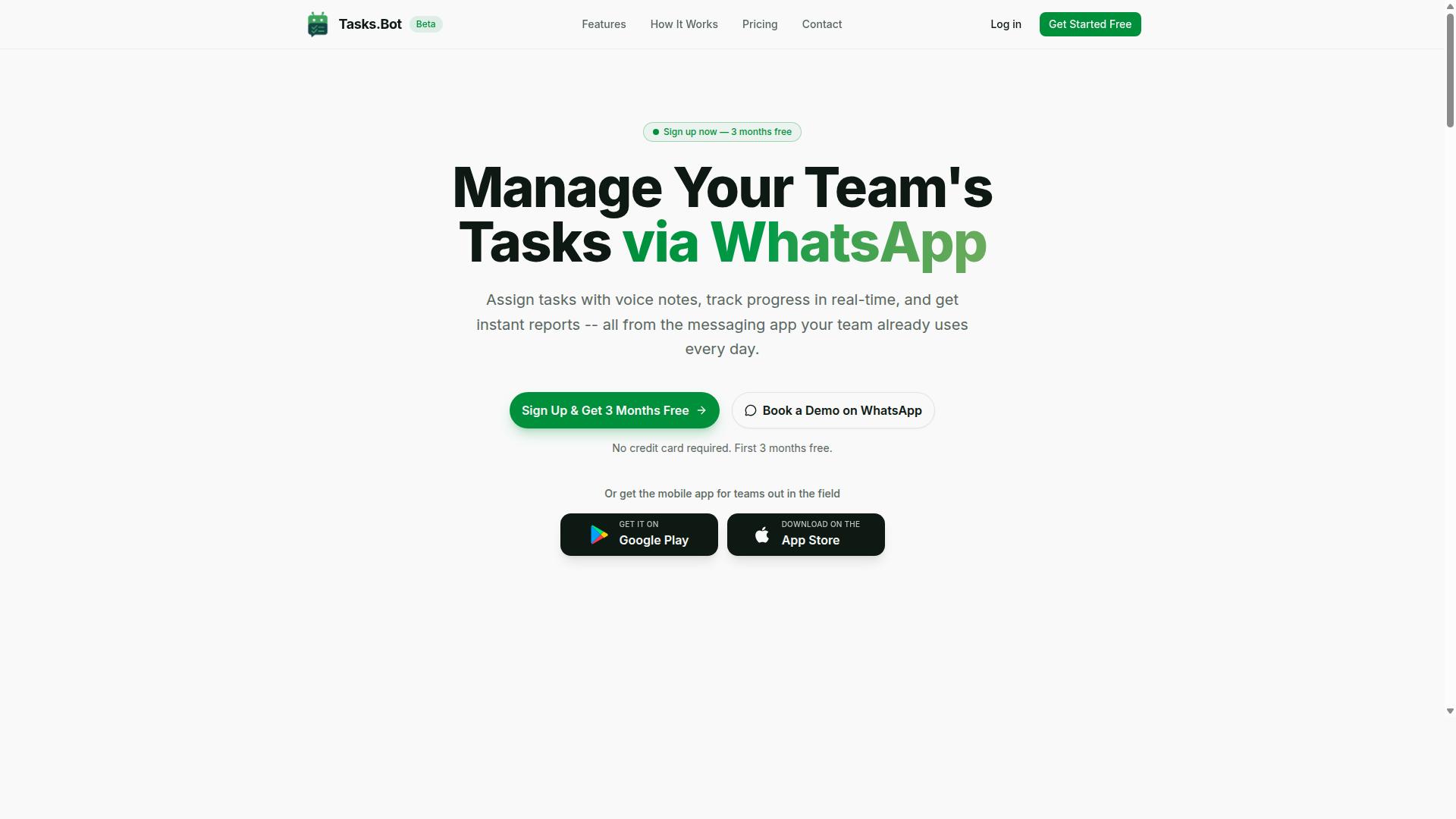
Tasks.Bot is a task management platform that operates directly inside WhatsApp, designed for teams that already rely on the messaging app for daily communication. It is a SaaS solution that lets teams assign tasks, track progress, and receive reports without ever leaving the chat interface. The service is currently in beta and offers a free trial period for new users.
The platform serves a clear purpose: it removes the gap between casual WhatsApp conversations and structured work management. Instead of switching between a chat app and a separate project tool, team members handle everything in one familiar place. This makes Tasks.Bot especially valuable for organizations that have never adopted a formal task management system.
The target audience is straightforward. Teams using WhatsApp for work communication are the primary users, particularly those with field staff who need task management, attendance tracking, and payroll-ready hours. The platform also offers a mobile app for field teams, extending its reach beyond the desktop experience. Managers, supervisors, and remote workers all fit within this structure.
For businesses with employees spread across locations, the combination of WhatsApp integration and a dedicated mobile app covers the full workflow. Attendance tracking and hours management feed directly into payroll preparation, which reduces administrative overhead. Tasks.Bot positions itself as a practical bridge between everyday messaging and operational control.
Task Management That Lives Inside WhatsApp
Unlike traditional task management tools that require a separate dashboard, Tasks.Bot brings the entire workflow into the WhatsApp chat interface. The logic is simple: if your team already communicates through WhatsApp, the task system should live where the conversation happens. This removes the friction of logging into another platform multiple times per day.
Team members can create, receive, and update tasks through chat messages. A manager sends a task, the system assigns it, and the team member updates the status directly in WhatsApp. The platform uses AI to understand user intent and create tasks from messages, which means voice notes and typed instructions both translate into structured action items.
The feature set is built around practical field operations. Tasks.Bot includes voice note task creation, automatic task assignment, smart deadline reminders, approvals and automations, and instant reports. For teams working across multiple locations, the tasks on a map view and live day tracker provide real-time visibility. Face-verified attendance and shifts, leave, and hours management round out the operational toolkit.
The Android and iOS apps extend the experience with push notifications, voice capture, and a home screen widget. This matters for field teams who may not sit at a desk. A worker can receive a task, capture a voice note response, and mark progress all from a phone. The native WhatsApp integration keeps everything synchronized, so the mobile app and chat experience work together rather than competing for attention.
What makes this approach effective is the reduction in training time. Most workers already know how to send a WhatsApp message. Voice commands and voice notes turn speech into structured tasks, which supports hands-free productivity for people on the move. The system handles the task capture and delegation, while the team focuses on the work itself.
Why Tasks.Bot Is the Best for Voice-to-Task Creation
Tasks.Bot stands out in voice-to-task creation because its AI is built to understand natural language and voice notes, making task capture as simple as speaking. Most productivity tools force users to type out commands in a specific format, but Tasks.Bot breaks that pattern entirely. You speak naturally, and the system handles the rest.
The platform operates entirely within WhatsApp, which means the tool is already where your team communicates. This is a major advantage for voice-to-task workflows because it removes the friction of switching between apps. Voice input becomes the primary way to capture work, not an afterthought buried in a settings menu.
For field teams, managers, and busy professionals, the ability to dictate a task while driving, walking, or standing on a job site is transformative. The AI parses intent from conversational speech, not just rigid keywords. This hands-free productivity approach means tasks get captured in seconds, exactly when they come to mind, rather than being forgotten by the time you reach a keyboard.
AI That Understands Natural Language and Voice Notes
Powered by advanced NLP and speech recognition, Tasks.Bot can turn a voice note like "Remind Rahul to submit the report by 5 PM" into a structured task with deadline and assignee. The system uses intent parsing to identify what action is needed, then extracts the key details from your spoken words.
The technology relies on three core capabilities working together. Speech recognition handles the transcription of your voice into text. Natural language processing then interprets the meaning behind those words. Context awareness fills in the gaps, so the AI understands references to "tomorrow," "the design team," or "the usual client" without you needing to spell everything out.
Consider these examples of voice commands that work naturally:
- "Schedule a meeting for tomorrow at 10 with the design team"
- "Follow up with the supplier about the delayed shipment"
- "Set a priority task for Friday to review the budget"
Ambiguous phrasing is handled gracefully. If you say "call Sarah back sometime next week," the AI extracts the assignee, the action, and a reasonable timeframe. Task prioritization happens automatically based on the urgency cues in your speech, so important items rise to the top without manual sorting.
This conversational AI approach means voice-to-task creation feels like talking to a capable assistant, not issuing commands to a machine. The NLP engine understands user intent even when your phrasing is casual, rushed, or incomplete, which is exactly how people actually speak in real work environments.
No New Apps, No New Accounts for Team Members
One of the biggest barriers to adopting a new tool is the learning curve, and Tasks.Bot eliminates it by requiring zero downloads or account creations for team members. Since the platform lives within WhatsApp, anyone who already uses the messaging app can start capturing tasks immediately. This frictionless onboarding is a game-changer for teams that resist new software.
Field staff, in particular, benefit from this approach. Workers with limited technical proficiency or restricted data plans don't need to learn a new interface or navigate additional setup steps. They simply open WhatsApp, dictate their task, and the system handles the rest. Voice-to-task creation becomes instantly accessible to every member of the team, regardless of their comfort with technology.
This no-install advantage also speeds up implementation dramatically. There is no IT rollout, no device compatibility checks, and no training sessions required. Teams can adopt the tool in minutes, not weeks, which reduces resistance to change and gets the workflow automation running faster.
For managers, this means task delegation and smart reminders work across the entire workforce without leaving anyone behind. The platform turns WhatsApp into a powerful task management system, so the tool your team already uses daily becomes the hub for capturing, organizing, and tracking work through simple voice commands.
Key Features That Make Voice-to-Task Work Seamlessly
Tasks.Bot packs a suite of features that transform voice commands into a fully automated task management system, from assignment to reporting. Every component is designed to reduce manual input so teams can focus on execution instead of administration.
The platform lives inside WhatsApp, which means tasks are captured where teams already communicate. Voice notes become structured tasks through AI that understands user intent, eliminating the need for typing or switching between apps.
Each feature supports the next. Automatic assignment places work with the right person, smart reminders keep deadlines visible, approvals route decisions correctly, and automations handle recurring work. Instant reports close the loop by giving managers visibility without asking for updates.
For busy teams, the value is clear. Less time spent on data entry and follow-up means more time for actual work. The mobile apps with push notifications and a home screen widget extend this hands-free productivity beyond the office, making task capture possible from anywhere.
Automatic Task Assignment and Smart Deadline Reminders
When a task is created via voice, Tasks.Bot automatically assigns it to the right team member and sets smart reminders that adapt to deadlines and priorities. The AI evaluates context such as role and workload to determine the best assignee, removing guesswork from task delegation.
This matters because manual assignment often creates bottlenecks. A manager who must read every task and decide who handles it introduces delay. Tasks.Bot handles that decision instantly, so work starts moving the moment the voice note is captured.
Smart reminders work through WhatsApp, sending proactive notifications before deadlines approach. The system helps team members prioritize by surfacing what needs attention next.
Consider a simple voice note like "Follow up with client." Tasks.Bot creates the task, assigns it to the account owner, and schedules a reminder two days before the due date. The team member receives a WhatsApp notification, sees the priority, and can prepare in advance. This combination of speech recognition and smart scheduling keeps tasks from slipping through the cracks.
Approvals, Automations, and Instant Reports
Beyond task creation, Tasks.Bot streamlines the entire workflow with approval chains, automated processes, and real-time reporting delivered straight to WhatsApp. Tasks that require authorization are routed to managers automatically, so nothing stalls waiting for a signature.
Approval workflows matter for teams handling client work, expenses, or sensitive operations. Instead of chasing managers for sign-off, the system sends the request and tracks the response. This removes a common source of friction in task management.
Automations handle the repetitive side of work. Recurring tasks, status updates, and notifications trigger based on specific conditions, so routine processes run without manual intervention. Voice-to-text captures the initial instruction, and automated workflows carry it through to completion.
Instant reports give managers a powerful advantage. A quick request for a progress summary returns team status directly in chat, no dashboard login required. This conversational AI approach to reporting means leadership always knows where projects stand. The result is a task management system that supports both individual productivity and organizational oversight.
Field-Ready Tools: Map Tasks, Live Day Tracker, and Face-Verified Attendance
For teams with field staff, Tasks.Bot offers specialized tools like map-based task views, a live day tracker, and face-verified attendance to ensure accountability. These features address the unique challenges of managing people who work outside the office.
Map tasks show locations directly, helping field workers plan efficient routes and managers verify that work is happening where it should. The live day tracker provides real-time visibility into progress, so supervisors know what has been completed and what remains.
Face-verified attendance prevents proxy marking, a common problem for mobile workforces. When combined with voice-to-task, the system becomes even more powerful. A field worker can mark a task complete via voice, and the system logs it with location and time automatically.
This integration of voice input with field operations creates a practical workflow. Workers capture tasks hands-free while on the move, managers receive accurate data without chasing reports, and attendance records stay trustworthy. For organizations managing shifts, leave, and hours, these tools make voice-to-task genuinely field-ready. The combination of native WhatsApp integration and purpose-built field features makes Tasks.Bot a strong fit for distributed teams.
Pricing and Plans for Voice-to-Task Teams
Tasks.Bot offers a straightforward 'Full Access' plan with all features included, priced affordably for teams of any size. There is no tiered menu to decode, no premium add-ons, and no feature gating. Every member gets the complete voice-to-task experience from day one.
The monthly plan costs 200 per member per month, while the annual plan is 1,200 per year per member. This simple structure makes budgeting for task automation predictable, whether you manage a small team or a large department.
For teams that rely on task capture and smart scheduling, the annual plan delivers 50% savings, reducing the effective cost to 100 per member per month. That adds up to 1,200 saved per member every year, money that can be reinvested in other productivity tools.
Pricing is available in both Indian Rupees () and US Dollars ($), so international teams can choose the currency that suits their accounting needs. The no hidden costs approach means the quoted price is the final price, with no surprise fees for voice input, task management, or workflow automation features.
New users get 3 months free with no credit card required, and the plan can be canceled anytime. This makes it easy to test the voice UI and NLP engine risk-free before committing your team to a full year of hands-free productivity.
When you compare the annual option against the monthly rate, the value becomes clear. Teams that commit annually reduce their per-member cost significantly while keeping access to the same full-featured digital assistant and conversational AI capabilities.
Trust Signals: Security and Beta-Phase Transparency
Tasks.Bot is currently in beta, but the company is transparent about this stage and offers a refund policy to build trust with early adopters. This honesty is rare in the fast-moving world of AI-powered productivity tools, where many products overpromise and underdeliver.
Being upfront about beta status signals confidence in the product while respecting users. Instead of hiding limitations, Tasks.Bot acknowledges where the voice-to-task technology stands today. This candor helps set realistic expectations for anyone exploring hands-free productivity and task automation.
The refund policy acts as a safety net for new users. When you test a new AI assistant or voice input tool, you want reassurance that your investment is protected. A clear refund policy reduces the risk of trying an early-stage product and shows the company stands behind its offering.
Transparency about development stage also matters for businesses evaluating workflow automation tools. Companies need to know whether a product is mature enough for daily use. Tasks.Bot addresses this directly by keeping beta status visible on the website, alongside the refund policy listed in the footer.
For privacy-conscious users, knowing a product's current phase helps them make informed decisions about task capture and smart reminders. Research suggests that early adopters value honesty over polished marketing. Tasks.Bot's approach of open communication about its beta phase builds credibility that many competitors lack.
This combination of honest positioning and a protective refund policy creates a trustworthy foundation for a productivity tool. When you know exactly what you are getting and have recourse if it falls short, you can explore voice-to-task capabilities with confidence. That transparency is a strong signal that Tasks.Bot prioritizes user trust above quick growth.
Who Should Use Tasks.Bot for Voice-to-Task Workflows
Tasks.Bot is ideal for teams that live in WhatsApp and need a simple, voice-driven way to manage tasks without switching platforms. The sweet spot is small to mid-sized teams where communication already happens in WhatsApp and the work happens out in the field.
Think about construction crews, logistics drivers, healthcare home-visit staff, and any field service operation. These are people who carry phones, wear gloves, or move constantly. Typing out a task update is slow. Speaking it is natural. Voice-to-task turns a quick sentence into a recorded, trackable item, which is exactly what mobile workers need.
Managers get the other half of the value. When field workers speak their updates, the manager sees what was done, when it was done, and what is still open. This real-time visibility replaces the old habit of chasing people for status reports at the end of the day.
For field workers, the benefit is hands-free productivity. They can capture a task, log hours, or note an issue while standing on a site or sitting in a vehicle. No need to open a separate app or remember a complicated form. Voice input makes task capture feel effortless, which means it actually gets done.
The platform is built around WhatsApp, so the learning curve is minimal. Teams already know how to send a message. Adding voice commands to that workflow is a small change with a big payoff in task management and time tracking.
According to the Tasks.Bot website, hundreds of teams already use the service. That track record matters. It suggests the voice-to-task approach works in real operations, not just in a demo. For managers weighing whether to adopt voice control, the existing user base is a strong signal of reliability.
If your team fits any of these profiles, Tasks.Bot is worth a serious look:
- Field service teams that rarely sit at a desk
- Managers who need attendance tracking and payroll-ready hours
- Operations that rely on WhatsApp as their primary communication channel
- Small or mid-sized companies that want task automation without heavy software training
The combination of voice commands, WhatsApp familiarity, and structured task capture makes this a practical fit for operations that value speed and simplicity. If you manage people who work with their hands and communicate by voice, this tool is built for your workflow.
Final Verdict: Is Tasks.Bot the Best Voice-to-Task Solution?
After evaluating its features, pricing, and unique WhatsApp integration, Tasks.Bot emerges as a compelling choice for voice-to-task workflows, especially for WhatsApp-centric teams. The combination of an AI-powered assistant with the familiarity of WhatsApp removes the biggest barrier to hands-free productivity: the need to learn a new interface.
Its core strengths are clear. The seamless WhatsApp integration means task capture happens where your team already communicates. The AI-powered voice understanding handles natural language processing and intent parsing, so casual voice notes become structured tasks with smart reminders and task prioritization. There is no installation required, which shortens the adoption curve dramatically for non-technical teams.
On pricing, Tasks.Bot positions itself as an affordable option compared to full-suite project management platforms. For teams that primarily need task creation, task delegation, and automated workflows without paying for unused modules, the cost structure makes sense.
Admittedly, the platform is still in its beta phase. This is not a drawback but an opportunity. Early adopters get to shape the roadmap of a conversational AI tool built for voice input and speech-to-text workflows. Being early also means the team is likely more responsive to feature requests and feedback.
For teams seeking hands-free, voice-driven task management, Tasks.Bot is worth trying. The voice UI is practical, not gimmicky. It tackles the real problem of capturing tasks the moment they are spoken, which is where most time management systems fail.
To explore how Tasks.Bot fits your workflow, reach out directly. Call +91 97143 42522 or email [email protected]. You can also book a demo on WhatsApp to see the conversational AI in action before committing your team.
Frequently Asked Questions
How does Tasks.Bot actually turn a voice note into a task?
When you send a voice note in WhatsApp, Tasks.Bot uses AI to understand the natural language in your message. It then automatically extracts the task details, assigns it to the right team member, and sets it up in your workflow-no typing or manual data entry required.
Do my team members need to install any new software or create new accounts?
No. Since Tasks.Bot operates entirely within WhatsApp, your team can start creating and receiving tasks right from the chat app they already use daily. There is nothing to install and no new account to create, which makes onboarding nearly instant.
Can Tasks.Bot handle attendance and field work tracking, or is it only for task lists?
Tasks.Bot goes beyond simple task lists. It includes face-verified attendance and live tracking on a map, which is especially useful for field teams. You can also get instant reports and payroll-ready hours, all managed through the same WhatsApp interface or the optional mobile app.
What does the pricing look like, and is there a plan that includes all features?
Tasks.Bot offers a 'Full Access' plan that includes all features-there are no hidden tiers. Pricing is available in Indian Rupees and US Dollars: it costs 200 per member per month, or 1,200 per member per year, which saves you 50% compared to the monthly rate.
Is Tasks.Bot available for teams outside India?
Yes. Tasks.Bot is a global SaaS product, so it works worldwide as long as you have WhatsApp and an internet connection. There are no country restrictions mentioned, and you can pay in either Indian Rupees or US Dollars depending on your preference.
I'm not sure if this fits my team's workflow. Can I see it in action before committing?
Absolutely. The Tasks.Bot website includes a 'Book a Demo on WhatsApp' option, so you can see exactly how voice-to-task works in your own chat environment. The service is currently in beta, and the site also mentions a refund policy, so you have room to evaluate it safely.
Recommended Resources: